Scotland Yard has urged Portuguese authorities to reopen the search for Madeleine McCann as detectives said there are 195 potential leads to finding her alive. The detective leading the Metropolitan Police review said the case can still be solved before officers released a picture of what she might now look like as a nine-year-old. Detective Chief Inspector Andy Redwood said he believes her disappearance was a stranger abduction, as he said there are 195 "investigative opportunities". Police refused to say what evidence they had uncovered to suggest Madeleine is alive. Mr Redwood confirmed that his team of more than 30 officers involved in the case had been out to Portugal seven times, including a visit to the family's holiday flat in Praia da Luz. It will be five years ago next week since the three-year-old went missing as her parents, Kate and Gerry McCann, dined with friends nearby. A spokesman for the McCanns said the family was pleased with the image. Mr Redwood said his 37 officers had dealt with 40,000 pieces of information but the "primacy still sits in Portugal" in the attempt to find her. Commander Simon Foy said: "Most significantly, the message we want to bring to you is that, on the evidence, there is a possibility that she is alive and we desperately need your help today to appeal directly to the public for information to support our investigation." Mr Redwood said "evidence that she is alive stems from the forensic view of the timeline" that there was the opportunity for her to be taken. Investigations show "there do appear to be gaps", he added. Detectives in Portugal are also understood to want the case reopened but must gain judicial approval via the courts.
Wednesday, 25 April 2012
Insecure websites to be named and shamed after checks
Companies that do not do enough to keep their websites secure are to be named and shamed to help improve security. The list of good and bad sites will be published regularly by the non-profit Trustworthy Internet Movement (TIM). A survey carried out to launch the group found that more than 52% of sites tested were using versions of security protocols known to be compromised. The group will test websites to see how well they have implemented basic security software. Security fundamentals The group has been set up by security experts and entrepreneurs frustrated by the slow pace of improvements in online safety. "We want to stimulate some initiatives and get something done," said TIM's founder Philippe Courtot, serial entrepreneur and chief executive of security firm Qualys. He has bankrolled the group with his own money. TIM has initially focused on a widely used technology known as the Secure Sockets Layer (SSL). Experts recruited to help with the initiative include SSL's inventor Dr Taher Elgamal; "white hat" hacker Moxie Marlinspike who has written extensively about attacking the protocol; and Michael Barrett, chief security officer at Paypal. Continue reading the main story “ Start Quote Everyone is now going to be able to see who has a good grade and who has a bad grade” Philippe Courtot Many websites use SSL to encrypt communications between them and their users. It is used to protect credit card numbers and other valuable data as it travels across the web. "SSL is one of the fundamental parts of the internet," said Mr Courtot. "It's what makes it trustworthy and right now it's not as secure as you think." Compromised certificates TIM plans a two-pronged attack on SSL. The first part would be to run automated tools against websites to test how well they had implemented SSL, said Mr Courtot. "We'll be making it public," he added. "Everyone is now going to be able to see who has a good grade and who has a bad grade." Early tests suggest that about 52% of sites checked ran a version of SSL known to be compromised. Companies who have done a bad job will be encouraged to improve and upgrade their implementations so it gets safer to use those sites. The second part of the initiative concerns the running of the bodies, known as certificate authorities, which guarantee that a website is what it claims to be. TIM said it would work with governments, industry bodies and companies to check that CAs are well run and had not been compromised. "It's a much more complex problem," said Mr Courtot. In 2011, two certificate authorities, DigiNotar and GlobalSign were found to have been compromised. In some cases this meant attackers eavesdropped on what should have been a secure communications channel. Steve Durbin, global vice president of the Information Security Forum which represents security specialists working in large corporations, said many of its members took responsibility for making sure sites were secure. "You cannot just say 'buyer beware'," he said. "That's not good enough anymore. They have a real a duty of care." He said corporations were also increasingly conscious of their reputation for providing safe and secure services to customers. Data breaches, hack attacks and poor security were all likely to hit share prices and could mean they lose customers, he noted.
Anti-depressants likely do more harm than good, study suggests
Commonly prescribed anti-depressants appear to be doing patients more harm than good, say researchers who have published a paper examining the impact of the medications on the entire body. See Also: Health & Medicine Pharmacology Birth Defects Mental Health Research Mind & Brain Depression Disorders and Syndromes Psychiatry Reference COX-2 inhibitor Psychoactive drug Seasonal affective disorder Anti-obesity drug "We need to be much more cautious about the widespread use of these drugs," says Paul Andrews, an evolutionary biologist at McMaster University and lead author of the article, published recently in the online journal Frontiers in Psychology. "It's important because millions of people are prescribed anti-depressants each year, and the conventional wisdom about these drugs is that they're safe and effective." Andrews and his colleagues examined previous patient studies into the effects of anti-depressants and determined that the benefits of most anti-depressants, even taken at their best, compare poorly to the risks, which include premature death in elderly patients. Anti-depressants are designed to relieve the symptoms of depression by increasing the levels of serotonin in the brain, where it regulates mood. The vast majority of serotonin that the body produces, though, is used for other purposes, including digestion, forming blood clots at wound sites, reproduction and development. What the researchers found is that anti-depressants have negative health effects on all processes normally regulated by serotonin. The findings include these elevated risks: developmental problems in infants problems with sexual stimulation and function and sperm development in adults digestive problems such as diarrhea, constipation, indigestion and bloating abnormal bleeding and stroke in the elderly The authors reviewed three recent studies showing that elderly anti-depressant users are more likely to die than non-users, even after taking other important variables into account. The higher death rates indicate that the overall effect of these drugs on the body is more harmful than beneficial. "Serotonin is an ancient chemical. It's intimately regulating many different processes, and when you interfere with these things you can expect, from an evolutionary perspective, that it's going to cause some harm," Andrews says. Millions of people are prescribed anti-depressants every year, and while the conclusions may seem surprising, Andrews says much of the evidence has long been apparent and available. "The thing that's been missing in the debates about anti-depressants is an overall assessment of all these negative effects relative to their potential beneficial effects," he says. "Most of this evidence has been out there for years and nobody has been looking at this basic issue." In previous research, Andrews and his colleagues had questioned the effectiveness of anti-depressants even for their prescribed function, finding that patients were more likely to suffer relapse after going off their medications as their brains worked to re-establish equilibrium. With even the intended function of anti-depressants in question, Andrews says it is important to look critically at their continuing use. "It could change the way we think about such major pharmaceutical drugs," he says. "You've got a minimal benefit, a laundry list of negative effects -- some small, some rare and some not so rare. The issue is: does the list of negative effects outweigh the minimal benefit?"
Madeleine McCann, the British girl who went missing while on holiday in Portugal half a decade ago, could still be alive, Scotland Yard said on Wednesday.

Madeleine McCann as she might look aged 9 Photo: Teri Blythe
Detectives released a new “age progression” image of the toddler, which they said showed what she would look like today at the age of nine.
On Wednesday, Britain’s biggest police force said that as a result of evidence uncovered during a review “they now believe there is a possibility Madeleine is still alive”.
Officers have so far identified nearly 200 new items for investigation within historic material and are also “developing what they believe to be genuinely new material”.
Scotland Yard urged Portuguese authorities to reopen the search for her amid the new "investigative opportunities".
Police said the image, created ahead of what would have been her ninth birthday on May 12, had been created in “close collaboration with the family”.
Dengue Fever Asian Mosquito Could Invade UK

The mosquito can carry dengue and chikungunya viruses
A mosquito that spreads tropical diseases including dengue fever may be poised to invade the UK because of climate change.
The Asian tiger mosquito has already been reported in France and Belgium and could be migrating north as winters become warmer and wetter.
Scientists have urged "wide surveillance" for the biting insect across countries of central and northern Europe, including the UK.
The mosquito can carry dengue and chikungunya viruses, both of which cause high fevers. The infections usually occur in tropical regions of Africa, Asia and South America.
Scientists led by Dr Samantha Martin, from the University of Liverpool, used climate models to predict how changing conditions might affect Asian tiger mosquito distribution.
They wrote in the Journal of the Royal Society Interface: "Mosquito climate suitability has significantly increased over the southern UK, northern France, the Benelux, parts of Germany, Italy, Sicily and the Balkan countries."
The research shows that parts of the UK could become hot-spots of Asian tiger mosquito activity between 2030 and 2050.
The mosquito has been introduced into Europe from Asia via goods shipments, mainly used tyres and bamboo.
Climate change is now shifting conditions suitable for the insect from southern Europe to central north-western areas.
The mosquito could survive in water butts and vases, and may find winter protection in greenhouses, said the researchers.
Tuesday, 24 April 2012
Opiates Killed 8 Americans In Afghanistan, Army Records Show
Eight American soldiers died of overdoses involving heroin, morphine or other opiates during deployments in Afghanistan in 2010 and 2011, according to U.S. Army investigative reports. The overdoses were revealed in documents detailing how the Army investigated a total of 56 soldiers, including the eight who fell victim to overdoses, on suspicion of possessing, using or distributing heroin and other opiates. At the same time, heroin use apparently is on the rise in the Army overall, as military statistics show that the number of soldiers testing positive for heroin has grown from 10 instances in fiscal year 2002 to 116 in fiscal year 2010. Army officials didn't respond to repeated requests for comment on Saturday. But records from the service's Criminal Investigation Command, obtained by the conservative legal group Judicial Watch, provided glimpses into how soldiers bought drugs from Afghan juveniles, an Afghan interpreter and in one case, an employee of a Defense Department contractor, who was eventually fired. The drug use is occurring in a country that is estimated to supply more than 90% of the world's opium, and the Taliban insurgency is believed to be stockpiling the drug to finance their activities, according to a 2009 U.N. study. While the records show some soldiers using heroin, much of the opiate abuse by U.S. soldiers in Afghanistan involves prescription drugs such Percocet, the Army documents show. Judicial Watch obtained the documents under the Freedom of Information of Act and provided them to CNN. Spokesman Col. Gary Kolb of the International Security Assistance Force, the NATO-led command in Afghanistan, verified the documents to CNN on Saturday. One fatal overdose occurred in June 2010 at Forward Operating Base Blessing, after a soldier asked another soldier to buy black tar opium from a local Afghan outside the base's entry control point. The first soldier died after consuming the opium like chewing tobacco and smoking pieces of it in a cigarette, the documents show. The reports even show soldier lingo for the drug -- calling it "Afghani dip" in one case where three soldiers were accused of using the opiate, the Army investigative reports show. The United States has 89,000 troops in Afghanistan. The U.S. death toll since the September 11, 2001, attacks that triggered the war has risen to more than 1,850, including 82 this year, according to the U.S. Department of Defense and U.S. Central Command. Tom Fitton, president of Judicial Watch, said his group was interested in soldiers' drug use partly because the risk was present during the Vietnam War. "You never want to see news of soldiers dying of drug use in Afghanistan," Fitton said. "Our concern is, will the military treat this as the problem that it is, and are the families of the soldiers aware of the added risk in this drug-infested country? "There is a dotted line between the uses. Prescription abuse can easily veer into heroin drug use," Fitton added. "Afghanistan is the capital of this opiate production and the temptation is great there and the opportunity for drug use all the more." The group is concerned that "there hasn't been enough public discussion, and we would encourage the leadership to discuss or talk about this issue more openly," Fitton said. In one case, a soldier bought heroin and the anti-anxiety drug Xanax from five "local national juveniles at multiple locations on Camp Phoenix, Afghanistan, and consumed them," one report states. Soldiers also distributed heroin, Percocet and other drugs among themselves, according to the reports. Another soldier fatally overdosed in December 2010 after taking several drugs, including morphine and codeine, though the drugs were not prescribed for him, the Army documents show. One female soldier broke into the Brigade Medical Supply Office at Forward Operating Base Shank and stole expired prescription narcotics including morphine, Percocet, Valium, fentanyl and lorazepam, the documents show. The investigative reports show soldiers using other drugs, including steroids and marijuana, and even hashish that was sold to U.S. servicemen by the Afghan National Army and Afghan National Police personnel, the reports state.
Friday, 20 April 2012
Landing aborted as Australian pilot was busy texting
Distracted by his mobile phone, a Jetstar pilot forgot to lower the aircraft's landing gear on approach to Singapore’s Changi Airport. He pulled up only 120 meters above the ground and landed his A320 with 220 passengers after the second approach. Indeed, why bother “turning off all portable electronic devices” if you are a captain? A pilot’s cellphone would never “interfere with aircraft navigation systems,” while you can also receive an “urgent” text message from your spouse asking you to get something from a Duty Free in Singapore. And who cares about all those stupid rules which forbid texting or speaking on your telephone while operating a vehicle? You are a captain – you are “in charge”. The distracted pilot had an impressive 13,000 hours of flying experience. And yet, he found it possible to reach for his telephone – buzzing with message alerts – when the plane hit an altitude of 2,000-2,500 feet (600-750 meters). At 1,000 feet (some 300 meters), the co-pilot checked the instruments and felt something was off. Surprisingly, he failed to figure out what exactly until a cockpit alert at 220 meters (720 feet) told the pilots the landing gear had not been lowered. At an altitude of 650 feet (200) meters the captain attempted to lower the gear until another alarm signaled that the plane had dipped below 500 feet (152 meters) – too close to the tarmac for the undercarriage to get safely into place. At this point, the co-pilot told investigators, he began the ascent. This happened at only 392 feet (some 120 meters) above ground. And the captain? He told investigators he was trying to unlock the phone to turn it off, claiming he simply forgot to do so before take-off. The Australian Transport Safety Bureau found out that problems had begun just after the autopilot was turned off on the flight from Darwin to Singapore on May 27, 2010.
Thursday, 19 April 2012
Phone data shows romance 'driven by women'
A study of mobile phone calls suggests that women call their spouse more than any other person. That changes as their daughters become old enough to have children, after which they become the most important person in their lives. The study has been published in the journal Scientific Reports. It also shows that men call their spouse most often for the first seven years of their relationship. They then shift their focus to other friends. The results come from an analysis of the texts of mobile phone calls of three million people. According to the study's co-author, Professor Robin Dunbar of Oxford University, UK, the investigation shows that pair-bonding is much more important to women than men. "It's the first really strong evidence that romantic relationships are driven by women," he told BBC News. "It's they who make the decision and once they have made their mind up, they just go for the poor bloke until he keels over and gives in!" But the data shows that women start to switch the preference of their best friend from about the mid-30s, and by the age of 45 a woman of a generation younger becomes the "new best friend", according to Professor Dunbar. Continue reading the main story “ Start Quote Human societies are moving back to a matriarchy” Prof Robin Dunbar Oxford University "What seems to happen is that women push the 'old man' out to become their second best friend, and he gets called much less often and all her attention is focussed on her daughters just at the point at which you are likely to see grandchildren arriving," he says. Prof Dunbar also claims that the findings suggest that human societies are moving away from a patriarchy back to a matriarchy. The aim of the project was to find out how close, intimate relationships vary over a lifetime. This kind of anthropological study is normally very difficult to do because it is hard for researchers to get such a big picture of people's lives. But by looking at an at an extremely large mobile phone database, they were able to track these changes extremely accurately. They had access to the age and sex of the callers, who between them made three billion calls and half a billion texts over a period of seven months. Intensely focussed The team wanted to find out how the gender preference of best friends, as defined by the frequency of the calling, changed over the course of a lifetime and differed between men and women. They found that men tend to choose a woman the same age as themselves - which the researchers presumed to be their girlfriend or wife - as a best friend much later in life than women do, and for a much shorter time. This occurs when they are in their early-30s, possibly during courtship, and stops after seven years or so. Women, however, choose a man of a similar age to be their best friend from the age of 20. He remains for about 15 years, after which time he's replaced by a daughter. The pendulum between the two sexes is swinging back towards women, says Prof Dunbar The researchers say that a woman's social world is intensely focussed a on one individual and will shift as a result of reproductive interests from being the mate to children and grandchildren. According to Prof Dunbar, the data suggests that "at root the important relationships are those between women and not those between men". "Men's relationships are too casual. They often function at a high level in a political sense, of course; but at the end of the day, the structure of society is driven by women, which is exactly what we see in primates," he explains. Many anthropologists argue that most human societies are patriarchal on the basis that in most communities men stay where they are born whereas the wives move. But Professor Dunbar and his colleagues are arguing that this only occurs in agriculturally based societies. "If you look at hunter-gatherers and you look at modern humans in modern post-industrial societies, we are much more matriarchal. It's almost as if the pendulum between the two sexes, power-wise, is swinging (back) as we move away from agriculture toward a knowledge-based economy," he says.
Secret Service scandal sheds light on sex tourism in Latin America
Type in "sex tourism" and "Brazil" in Google, and the first site that comes up is not a news report or academic study, but advice on going rates and how to hire prostitutes. But ahead of the 2014 World Cup and 2016 Olympics, officials are starting to clamp down on the country's image as a haven for sex tourism. Brazil's Tourism Ministry recently said it identified more than 2,000 sites advertising the South American giant's sex industry, many of them hosted in the US. To counter the reputation, the tourism ministry has stepped up efforts to advertise Brazil's natural beauties like beaches and the Amazon, instead of bodies for sale. And they have circulated information reminding visitors that sexual exploitation of minors is a crime. Brazil's preventive efforts seem more crucial than ever after the scandal in Cartagena, Colombia, during the Sixth Summit of the Americas last weekend. Some 11 US Secret Service agents were sent home for allegedly hiring prostitutes in the steamy colonial city, also a major destination for sex tourism. “Large events create an obvious clientele and traffickers recognize an opportunity to make money,” says Heather Smith-Cannoy, who teaches international relations at Lewis & Clark College in Portland, Oregon. “I think that in many places around the world there is a 'boys will be boys' attitude about the patronizing of prostitutes," Ms. Smith-Cannoy says. But when considering the combination of large profits for traffickers, and pimps or hustlers, and a relaxed cultural attitude about visiting prostitutes "we can begin to understand both the supply and the demand side of this industry,” says Smith-Cannoy. The trafficking–tourism link Sex “tourism" is nothing new. By some accounts it dates back to the 15th century, with Columbus's arrival to the Americas. As the middle class grew in industrialized nations, and the opportunities to travel with it, the formal industry was developed. Prostitution is tolerated to varying degrees in Latin America, but it is the human trafficking associated with sex tourism, especially that of minors, that alarms officials most. (The case of Cartagena did not involve minors.) According to the Coalition Against Trafficking of Women and Girls in Latin America and the Caribbean (CATW-LAC), 500,000 women and girls from Latin America and the Caribbean are sexually exploited each year. Not all prostitution involves sex trafficking, a multibillion dollar industry, but the nongovernmental organization World Vision estimates that up to a quarter of women in prostitution have been trafficked. At the same time, the majority of human trafficking victims — 79 percent — are brought into the sex trade, according to the United Nations. Countries in Asia, notably Thailand, have long been at the center of the problem, but Latin America is starting to play a larger role. “While most trafficking victims still appear to originate from South and Southeast Asia or the former Soviet Union, human trafficking is also a growing problem in Latin America,” writes Clare Ribando Seelke in a 2012 Congressional Research Service report. Poverty, displacement from rural areas, and increased demand for prostitution all play a role in the growth of sexual exploitation, says Humberto Rodriguez, the communication officer of Fundacion Renacer, a Colombia-based group that combats the sexual exploitation of youths in the country. Anywhere the tourism industry grows, he says, so does the opportunity for sexual tourism. 'Not enough is being done' Within sex tourism, the exploitation of children is the biggest concern. According to the US State Department 2011 report on the trafficking of persons, Brazil, Costa Rica, the Dominican Republic, and Nicaragua all have significant child sex tourist industries. Colombia, it says, is also “a destination for foreign child sex tourists from the United States and Europe, particularly to coastal cities such as Cartagena and Barranquilla.” Countries around the globe have addressed the problem of human trafficking in general since the UN Protocol to Prevent, Suppress, and Punish Trafficking in Persons, Especially Women and Children, was adopted in 2000, but many say not enough is being done. The US State Department assesses efforts around the globe to combat human trafficking. In 2010, 80 percent of countries in South America were placed on the Tier 2 list, which means they were not fully complying with the US Trafficking Victims Protection Act, while 60 percent of countries in Central America and the Caribbean were on the Tier 2 Watch List. Cuba fell to the lowest level of cooperation, Tier 3. The State Department says that prostitution of children over 16 is legal in Cuba, leaving those over the legal age vulnerable to commercial sexual exploitation. Venezuela fell to Tier 3 in the 2011 report. Colombia sits on the Tier 1 list, and while the case of the US Secret Service agents does not fall into Fundacion Renacer's work — as it did not involve children — Mr. Rodriguez says the case may not have generated so much attention in the past. “People are paying attention to it now,” says Rodriguez. Through their work and an international certification program called The Code, which brings tourism operators into the fight to prevent the use of children in sex tourism, society in general is more aware of prostitution, he says. Efforts like these are particularly important as countries become hosts to big events like the Summit of the Americas, or as crises occur. An increased demand for prostitution increases human sex trafficking rings, says Cannoy-Smith. She and a co-author have researched the impact of UN peacekeeping forces in Kosovo, Haiti, and Sierra Leone on trafficking. “When the UN intervenes in civil conflicts, the peacekeepers themselves have often been linked to running and patronizing trafficking rings,” Smith-Cannoy says. “Again, I think that poverty, desperation, the specter of large profits, and relaxed cultural attitudes make these dynamics possible.”
Wednesday, 18 April 2012
Sex Robots Will Revolutionize Sex Tourism,
They don't spread disease and they can't be sold into sex slavery. Those are just two of the advantages of robot prostitutes, which will be edging out their human competition in the sex tourism market by the year 2050, according to an article published in the journal Futures. The Dominion Post, which found the study, writes that sex tourists will shell out about $10,000 Euros for services ranging from massages and lap dances to intercourse, according to the article. The researchers lay out why this scenario will be the future of sex tourism: Human trafficking, sexual transmitted diseases, beauty and physical perfection, pleasure for sex toys, emotional connection to robots and the importance of sex in Amsterdam are all driving forces. But some are not so sure that robots will be replacing female sex workers any time soon. CBS Las Vegas spoke to Dennis Hof, owner of the Moonlite Bunny Ranch in Carson City, Nev. “Those Australian researchers ought to come to the Bunny Ranch to see what real American sex is like – there’s no way to duplicate it,” Hof told CBS Las Vegas. “At the Bunny Ranch, we say ‘it’s not just the sex, it’s an adventure’ – and often times it’s more about the adventure than it is the sex.”
10 things not to say to someone when they're ill
'People really did feel the need to reassure me that my hideousness was plain to see.' Illustration: David McCoy for the Guardian
What no one ever tells you about serious illness is that it places you at the centre of a maelstrom of concerned attention from family and friends. Of course it does. That's one of the nice things. It's actually the only nice thing. But it's also a rather tricky challenge, at a time when you may feel – just slightly – that you have enough on your plate. Suddenly, on top of everything else, you are required to manage the emotional requirements of all those who are dear to you, and also, weirdly, one or two people who you don't see from one year to the next, but who suddenly decide that they really have to be at your bedside, doling out homilies, 24 hours a day. It's lovely to hear from people when you're ill. But it's also lovely when they add: "No need to reply." The biggest shock, when I was diagnosed with cancer the summer before last, was quickly observing that people can be quite competitive in their determination to "be there for you", and occasionally unable to hide their chagrin when some other chum has been awarded a particularly sensitive role at a particularly sensitive medical consultation. Nobody means to be intrusive or irritating. It's all done with the finest intentions. But, God, it's a pain. Yet by not saying 10 simple things, you too, can be the friend in need that you want to be.
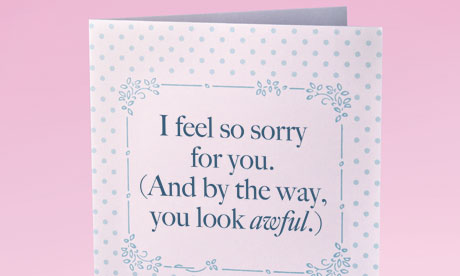
1 "I feel so sorry for you"
It's amazing, the number of people who imagine that it feels just great to be the object of pity. Don't even say "I feel so sorry for you" with your eyes. One of my friends was just brilliant at mimicking the doleful-puppy-poor-you gaze, and when I had been subjected to a sustained bout of it, I used to crawl over to the local pub for lunch with him, just so that he could make me laugh by doing it. Don't say "I feel so sorry for you" with your hand either. When someone patted my thigh, or silently rested their paw on it, often employing the exasperating form of cranial communication known as "sidehead" at the same time, I actually wanted to deck them. Do say: "I so wish you didn't have to go through this ghastly time." That acknowledges that you are still a sentient being, an active participant in your own drama, not just, all of a sudden, A Helpless Victim.
2 "If anyone can beat this, it's you"
Funnily enough, it's not comforting to be told that you have to go into battle with your disease, like some kind of medieval knight on a romantic quest. Submitting to medical science, in the hope of a cure, is just that – a submission. The idea that illness is a character test, with recovery as a reward for the valiant, is glib to the point of insult. Do say: "My mum had this 20 years ago, and she's in Bengal now, travelling with an acrobatic circus." (Though not if that isn't true.)
3 "You're looking well"
One doesn't want to be told that one's privations are invisible to the naked eye. Anyway, one is never too ill to look in a mirror, and see a great big moon-face, bloated with steroids and sporting the bright red panda eyes that are triggered by that most aggressive and efficient of breast-cancer drugs, Docetaxel. I knew I looked like death warmed up, not least because I felt like death warmed up. Nobody wants to be patronised with ridiculous lies. They are embarrassing for both speaker and listener. If your sick pal wants to discuss her appearance, she'll ask you what you reckon. It'll be a leading question, so take your cue from her.
4 "You're looking terrible"
I know it sounds improbable. But people really did feel the need to reassure me that my hideousness was plain to see. One person told me that while I'd put on a lot of weight, I'd of course be able to go on a diet as soon as I was better. I wouldn't have minded quite so much, if she hadn't arrived bearing a giant mound of snacks and cakes, a great, indiscriminate pile of stuff that suggested she'd been awarded four minutes in Whole Foods by Dale Winton, in a nightmarish haute-bourgeois version of Supermarket Sweep. And, in fact, I haven't gone on a diet. Somehow, being a size 10 doesn't seem tremendously importantany longer. On the other hand, when I said: "Don't I look monstrous?" I was asking people to help me to laugh at myself – which many did – and to tell me that this too would pass. One of my friends took photographs of me, behind a curtain in the hospital, looking comically interfered with by surgeons, and festooned with tubes and drains full of bloody fluid. We laughed so much that I probably came nearer to death right then than at any other point.
5 "Let me know the results"
Oddly, one doesn't particularly want to feel obliged to hit the social networks the moment one returns from long, complicated, stressful and invasive tests, which ultimately delivered news you simply didn't want to hear. Of course, this request is made because people are worried. But, a bit of worry is easier to bear than the process of coming to terms with news that confirms another round of debilitating, soul-crushing treatment. If people do want to talk about such matters, they really need to be allowed some control over when, how and to whom. Contacting their very nearest and dearest instead is fine, as is volunteering to spread the bad tidings to others who are also anxious.
6 "Whatever I can do to help"
Apart from anything else, it's boring. Everybody says it, even though your assumption tends to be that people do want to help, of course. That doesn't mean that help should not be offered. But "Can I pick the children up from school on Tuesdays?" or "Can I come round with a fish pie and a Mad Men box set?" is greatly preferable to: "Can I saddle you with the further responsibility of thinking up a task for me?" If you do happen to be on the receiving end of "whatever I can do to help", be shameless. Delegate with steely and ruthless intent.
7 "Oh, no, your worries are unfounded"
Especially when those worries are extremely founded indeed. Like a lot of women, when I was first diagnosed, I was disproportionately focused on the prospect of losing my hair. One friend, every time I tried to discuss this with her, would assert – baselessly – that this wasn't as likely to happen as it used to be. Actually, it's still very likely, and indeed it came to pass. But the crucial thing was this: I didn't want to talk about how pointless it was to be fearful. I wanted to talk about how sorely I dreaded the day when I was bald. When people want to talk about their fears, they want to talk about their fears, not to be told, quite blatantly, that their fears are imaginary. Even when they are imaginary, there are more subtle ways of offering assurance than blank rebuttal. Usually, an ill person brings something up because they feel a need to discuss it. Denying them that need is a bit brutal.
8 "What does chemotherapy [for example] feel like?"
It is staggering, the number of people who find it impossible to restrain their curiosity. Swaths of folk appear to imagine that exactly what you need, in your vulnerability, is a long and technical Q&A during which you furnish them with exhaustive detail pertaining to the most shit thing that's ever happened to your body in your life. If someone wants to talk about their procedures or their symptoms, they will. If you have to ask questions, that's prima facie evidence that this is not what they'd discuss, if only they could be gifted with just a smidgeon of control over the conversational initiative. Again, the golden rule is: take your lead from the person undergoing the experience. I tended to want my mind taken off all that stuff, and have a nice chat about nice things. One of my friends, asked by another what she had been up to lately, found herself saying she'd had a great time visiting Deborah in hospital after her mastectomy. It had indeed been a lively visit. Eight lovely people had turned up all at once, and it had been quite the rambunctious gathering. When she told me that it had been an absurd social highlight for her, I felt fantastically proud.
9 "I really must see you"
Don't say it, particularly, if you are then going to indulge in some long and complicated series of exchanges about your own busy life and the tremendous difficulty you have in finding an actual window, even though this appointment is so awfully important to you. At one point, I was sitting in a chemotherapy suite, large and painful cannula in the back of my hand, pecking out texts to somebody who had to sort something out this week, and wouldn't take "Let's do this later" for an answer. When I reluctantly picked a particular time from the list she had bossily pinged over, she replied that she'd have to bring her toddler son with her if itreally had to be then. I knew I couldn't handle a tiny visitor (and wasn't sure about the ability of the tiny visitor to handle it either), so we then arranged something else. A few days later, at the very time of predicted childcare crisis, I saw a tweet from her, declaring that she was wearing a new cocktail dress and held up in traffic on her way to a long-anticipated and very glamorous do. She had clearly just buggered up her dates and didn't want to say: "Whoops. Actually, I'll be at a PA-A-ARDEEEEE." Fair enough. Sweet, really. Nevertheless, the planning thing is an arse. I liked it when people just said, "Can I come by after work this evening?" or, even better, "I've got tickets to the theatre on the 25th. Tell me on the day if you can face it."
10 "I'm so terribly upset about your condition"
One friend, when I told her the initial news, blurted out: "I can't cope without you!" and unleashed a flood of tears. (I hadn't sobbed myself at that point. I never did.) Ages later, when she emerged from the loo at the pub I had designated as Telling People HQ, she explained that she'd been caterwauling unrestrainedly when a kind lady asked her what was wrong. Having sketched out her troubles, she got this reply, or something like it: "What? You're weeping in the lavatory, while your friend is in the bar having breast cancer? Pull yourself together, and get out there." This had inspired another torrent of waterworks. And that is the most important thing to remember, when your friend is facing a frightening and possibly fatal illness: it's not, not, not about you. If you're too upset to be in a position to comfort your friend, send cards, send flowers, send presents. But don't send your ailing chum a passionate storm of your own wild grief, personally delivered. It's a little too needy, under the circs.
If you recognise things that you have said or done yourself within this list, don't feel bad about it, at all. I most certainly have, and I've said and done much, much worse too; it took being on the receiving end before I realised what it could feel like. The thing is this: giant illness is a time of great intensity, and even the most cack-handed expressions of support or love are better than a smack in the face with a wet tea-towel. People feel helpless when they see that their friend is suffering. Sometimes – often – they say the wrong thing. But they are there, doing the best that they can, at a terrible, abject time. That's the most important thing of all. I look back on those grisly moments of ineptitude and clumsiness with exasperated amusement and tender, despairing, deep, deep fondness. The great lesson I learned from having cancer, was how splendid my friends were, whatever their odd little longueurs. They all, in their different ways, let me know that they loved me, and that is the most helpful thing of all. I'm so lucky to have them.
Tuesday, 17 April 2012
Energy-rich Qatar seeks la dolce vita with purchase of luxury resorts on Italy’s Sardinia isle
Qatar signed a deal Monday to buy the operator of four luxury resorts and other properties on the island of Sardinia as the wealthy Gulf emirate looks to bolster ties with Italy. The purchase coincided with a visit to Rome by the country’s emir. It is the latest deal in a European shopping spree that has given the natural-gas rich state a stake in European banks, energy companies and some of the continent’s best known brands. 0 Comments Weigh InCorrections? Personal Post State-owned Qatar Holding, an arm of the country’s sovereign wealth fund, said it will acquire resort operator Smeralda Holding from Los Angeles-based real estate investment firm Colony Capital. The deal includes the Cala di Volpe, Pitrizza, Romazzino and Cervo hotels, a marina and shipyard, a golf club and a 51 percent interest in 2,290 hectares (5,660 acres) of undeveloped land nearby. Qatar Holding plans to keep Smeralda’s existing management, and said Starwood Hotels and Resorts Worldwide Inc. will continue to run the hotels. Financial terms were not disclosed. The deal must still be approved by Italian regulators. The deal was announced as Italian Premier Mario Monti held talks with Qatar’s emir Sheik Hamad bin Khalifa Al Thani at a government villa in Rome. Monti hailed the visit as way for the countries to strengthen their friendship. “I am very happy for this meeting because it was (an) occasion to consolidate a strategic relationship between the two countries,” Monti told a news conference after the talks. The emir told reporters that Qatar’s sovereign fund is looking for ways to invest in Italy. When asked what factors discouraged investment in Italy, the emir said “corruption, first of all,” according to Monti. Among the accords signed Monday was one aimed at boosting efforts to fight graft and crime. Another raises the number of passenger flights between the countries from 14 to 35 weekly, and cargo flights from two to seven, Monti said. Monti promised Italian help to Qatar as it prepares to host soccer’s 2022 World Cup. “Italy has unique know-how and can contribute to the success” of the sporting event, the Italian leader said. Over the past several years, Qatar has used its vast energy wealth to amass a diverse portfolio of European properties. Its holdings on the continent include stakes in Barclays PLC, Credit Suisse Group, Volkswagen AG, and the London Stock Exchange. It acquired stakes in Spanish power utility Iberdrola SA and electric company Energias de Portugal last year. Qatari investors control French soccer team Paris Saint-Germain and Spanish club Malaga, while the logo of state-sponsored nonprofit Qatar Foundation graces the jerseys of another Spanish team, Barcelona.
Monday, 16 April 2012
Sterling rose to its highest in 19 months against the euro on Monday and was poised for more gains as concerns grew about debt problems in Spain
Sterling rose to its highest in 19 months against the euro on Monday and was poised for more gains as concerns grew about debt problems in Spain prompting investors to seek alternatives to the common currency. Spanish 10-year government bond yields broke above 6 percent for the first time this year, sparking worries about a new bout of financial stress in the euro zone and weighing broadly on the euro. With recent data suggesting the UK economy is showing some signs of improvement, investors have bought sterling as they pull out of euro zone assets. The pound also benefited after Standard & Poor's reaffirmed Britain's top-notch AAA credit rating on Friday, reflecting an expectation that the government will continue to consolidate its public finances. "Although UK data is likely to remain mixed it's a lot better than what markets are expecting from Europe, which means a gradual grind lower in euro/sterling," said Derek Halpenny, European Head of Global Currency Research at BTMU. The euro lost around half a percent on the day to hit 82.10 pence, its weakest since September
British terror supergrass sentence cut by two years
jailed British terrorist has had his sentence cut by two years in a supergrass deal after giving evidence about an al Qaeda-linked “martyrdom” plot in New York, it was revealed today. Former teacher Saajid Badat was jailed for 13 years in 2005 for plotting with shoe bomber Richard Reid to blow up a transatlantic airliner in 2001 in what an Old Bailey judge said was a “wicked and inhuman” plot. He has now had his term reduced by two years under the first “supergrass” deal involving a terror convict, after providing intelligence to US prosecutors investigating an alleged plot to blow up the New York subway on the eighth anniversary of the 9/11 attack. Details of the deal — kept secret for more than two years — were revealed today by the Crown Prosecution Service as a trial of the alleged al Qaeda plotters began in New York. Defendant Adis Medanjanin, a 27-year-old Bosnian-born US citizen, is charged with conspiring to use a weapon of mass destruction, conspiring to commit murder in a foreign country, and providing “material support” to al Qaeda. He is said to have had terrorist training in Pakistan in 2008 and then returned to begin a plot to use beauty parlour chemicals to blow up the subway. Badat, from Gloucester, joined Reid’s shoe bomb conspiracy but pulled out at the last minute.
Sunday, 15 April 2012
Hillary Clinton Caught On Camera Drinking Cerveza, Doing the Rumba in Cartagena
In Cartagena, Colombia, for the sixth Summit of the Americas, Secretary of State Hillary Clinton was spotted late Saturday night taking a breather from running the world to down a few drinks and dance the diplomatic doldrums away with her staffers and security agents at Café

SURF AIR, a Californian start-up, has a novel business model: for a monthly fee you can fly with the airline as much as you want.
Is buffet-style air travel the wave of the future? JetBlue and Sun Country Airlines have both already tried offering all-you-can-fly passes, but so far no carrier has built its business model exclusively on a buffet plan. The idea isn't bad, but some scepticism is warranted. At $790 a month, Surf Air's flying plan will probably only appeal to business travellers who often go to the same places and rich Californians in long-distance relationships. Will that customer base allow Surf Air to make a profit? Maybe: 20m frequent flyers jetted between San Francisco and Los Angeles in 2011, according to the company's numbers. The airline plans to launch with service between Palo Alto, Monterey, Santa Barbara and Los Angeles, but it still needs to secure regulatory approval, according to a company press release. Frequent flyers make up a huge portion of the business-traveller population, and almost every airline relies on business travellers to get (and stay) in the black. There is surely some group of private-jet-sharing business travellers who might be attracted to an all-you-can-jet airline as a cheaper alternative. A lot will depend on how many flights and how much convenience Surf Air can offer, and how quickly it can expand service. The company's promises certainly seem attractive: [Surf Air will offer] its members 30-second booking and cancellations, travel to and from uncongested regional airports, and an easy arrive-and-fly process with no hassle, no lines and no extra fees. It's easy to make promises, though. It's much harder to run a profitable airline. As Gulliver often notes, the American airline sector overall has never really made any money—in fact, total earnings over the entire history of the industry are minus $33 billion. That, of course, suggests that existing airlines might be doing it wrong. Maybe all-you-can-fly really is the way to go. It's at least worth a shot. I'll be eager to see what people think of the final product—assuming regulators give the go-ahead.
British Embassy responds to health allegations in the Spanish press
Some Spanish media have criticised the British Embassy webpage which gives advice on how to get the most out of the Spanish health system. Following an article in ABC Spanish newspaper on Friday which highlighted the advice given to Britons by the British Embassy in Madrid on their webpage, explaining how to get the most from the Spanish Health Service, there have been some comments about ‘health tourism’, and in these tight times and with the health services in Spain facing a 7 billion € cuts this year several comments have been made. The Minister for Hacienda and Public Administration, Cristóbal Montoro, for example, has been speaking on Radio Nacional and highlighted what he described as ‘the abuses of the foreigners’ of different Spanish medical services. ‘We must avoid the foreigners abusing the Health Service in Spain’, he said, continuing ‘There are Europeans who come to Spain to use services which are not available in their own respective countries’. The Spanish Government has announced it will ask the European Commission to ensure the proper use of the free movement of persons between the EU members and the healthcare system in different countries. The Secretary General in the Health Ministry, Pilar Farjas, commented on the British Embassy guide and said that the Spanish Government since coming to power is investigating ‘where the serious problems of sustainability of the system come from, including its fraudulent use’. On Saturday ABC criticised the British charity, Age Concern. It says Age Concern is giving advice to British people, and foreigners from other countries on how to get the most from the Spanish health and social services. The paper notes that Age Concern has been in Spain since 1994 and says its ‘network’ has extended to Torrevieja, Baleares with a presence on the four islands, Cartagena and Estepona. Following this discussion and criticism, the British Embassy released a statement in Spanish on its website on Saturday. It says that the British Government does not approve or promote ‘health tourism’. It says the object of the advice given by the British Embassy is to guarantee that the British citizens who are in Spain, be it residents or tourists, clearly meet the requirements of Spanish and European legislation regarding their rights and obligations. The British Embassy statement notes that more than 13 million British citizens travel to Spain each year, and that it is clearing in the interests of both countries that these citizens, in case of need, know how to use the Spanish health system correctly. The Embassy considers that this avoids unnecessary administrative costs and guarantees that the U.K. can reimburse Spain correctly and efficiently in line with the pertinent European legislation. The advice we give in our web page clearly establishes that the European Health Card does not cover those people who travel to Spain with the concrete objective of undergoing a medical treatment. Also the Embassy statement notes that many Britons who are living in Spain have the right to use the Spanish health and Social Security system is the same way that Spanish citizens living in Britain has the right to use the British Health Service. The objective of our advice is to ensure that those who use the system do so in line with Spanish legislation, which includes the need to register on the Padrón census. The British Embassy also notes that the British and Spanish governments cooperate very closely on health matters, and says that British tourists represent about 24% of all the tourists who travel to Spain. The contribution of the UK to the Spanish tourist industry is put at 10 billion € a year, or 1% of Spain’s GDP. The statement ends that the British Government is committed to guarantee that this important bilateral relation is solidly built, in line with European legislation, acting on a base of correct, legal and efficient access to the public health service.
China cuts off internet access in bid to exert control
Chinese users found themselves unable to connect to all foreign websites, while users in Hong Kong and the United States reported in turn that they could not access Chinese sites. The world's largest internet population, of some 500 million people, had been walled in. Users in several Chinese provinces, including Guangdong, Beijing, Shanghai, Jiangsu and Hubei, complained they were unable to connect to the outside world. Initially, Chinese commentators linked the problems to maintenance work, perhaps stemming from the aftermath of the 8.5 magnitude earthquake off the coast of Sumatra. However, analysts said that if the network had been down, domestic Chinese sites would also have been affected, rather than just foreign sites.
Western embassies targeted in Afghanistan attacks
Gunmen have launched multiple attacks across the Afghan capital Kabul. Western embassies in the heavily-guarded, central diplomatic area are understood to be among the targets as well as the parliament building in the west. There are reports that up to seven different locations have been hit. The Taliban has admitted responsibility, saying their main targets were the British and German embassies. There is no word at this stage on any casualties.
Taliban free hundreds from Pakistan prison
Hundreds of prisoners are believed to have escaped from a jail in northwest Pakistan after it was attacked by anti-government fighters armed with guns and rocket-propelled grenades. Some of those who escaped from the facility in the town of Bannu, in the Khyber Pakhtunkhwa province, early on Sunday morning were "militants", an intelligence official told the Reuters news agency. "Dozens of militants attacked Bannu's Central Jail in the early hours of the morning, and more 300 prisoners have escaped," Mir Sahib Jan, the official, said. In Depth Profile: Pakistani Taliban "There was intense gunfire, and rocket-propelled grenades were also used." Many of those who escaped following the raid were convicted Tehreek-e-Taliban Pakistan (TTP) fighters, Al Jazeera's Kamal Hyder reported from Lahore. A prison official in Bannu confirmed that "384 prisoners have escaped". A police official identified one of the inmates who escaped as a "dangerous prisoner", who took part in one of the attempts to kill the former president, Pervez Musharraf. The TTP, an umbrella organisation for anti-government groups that are loosely allied with the Taliban in Afghanistan and al-Qaeda, took responsibility for the attack. A spokesman for Hakeemullah Mehsud, TTP's leader, confirmed to Al Jazeera that the group was responsible for the attack. Another Taliban spokesman told Reuters: "We have freed hundreds of our comrades in Bannu in this attack. Several of our people have reached their destinations, others are on their way.". Our correspondent said the attack took place in the early morning and had resulted in an exchange of fire that had left several people wounded. "After the attack the paramilitary and regular military forces came to that location and tried to surround the area," he said. "They have arrested up to a dozen men, but most of the people have indeed escaped." The injured were rushed to a local hospital in Bannu. Sources told Al Jazeera that as many as 150 fighters were involved in the attack. After blowing up the gates of the main prison at around 1:30am local time (20:30 GMT on Saturday), they entered the compound and freed the inmates, the sources said. The attackers had arranged for the transportation of the inmates from the facility. A police official told Reuters that Bannu's Central Jail held 944 prisoners in total, and that six cell blocks had been targeted in the attack.
Friday, 13 April 2012
Surf Air: Can an all-you-can-fly airline possibly work?
SURF AIR, a Californian start-up, has a novel business model: for a monthly fee you can fly with the airline as much as you want. Is buffet-style air travel the wave of the future? JetBlue and Sun Country Airlines have both already tried offering all-you-can-fly passes, but so far no carrier has built its business model exclusively on a buffet plan. The idea isn't bad, but some scepticism is warranted. At $790 a month, Surf Air's flying plan will probably only appeal to business travellers who often go to the same places and rich Californians in long-distance relationships. Will that customer base allow Surf Air to make a profit? Maybe: 20m frequent flyers jetted between San Francisco and Los Angeles in 2011, according to the company's numbers. The airline plans to launch with service between Palo Alto, Monterey, Santa Barbara and Los Angeles, but it still needs to secure regulatory approval, according to a company press release. Frequent flyers make up a huge portion of the business-traveller population, and almost every airline relies on business travellers to get (and stay) in the black. There is surely some group of private-jet-sharing business travellers who might be attracted to an all-you-can-jet airline as a cheaper alternative. A lot will depend on how many flights and how much convenience Surf Air can offer, and how quickly it can expand service. The company's promises certainly seem attractive: [Surf Air will offer] its members 30-second booking and cancellations, travel to and from uncongested regional airports, and an easy arrive-and-fly process with no hassle, no lines and no extra fees. It's easy to make promises, though. It's much harder to run a profitable airline. As Gulliver often notes, the American airline sector overall has never really made any money—in fact, total earnings over the entire history of the industry are minus $33 billion. That, of course, suggests that existing airlines might be doing it wrong. Maybe all-you-can-fly really is the way to go. It's at least worth a shot. I'll be eager to see what people think of the final product—assuming regulators give the go-ahead.
Worrying is good for you and reflects higher IQ
It evolved in humans along with intelligence to make them more adept at avoiding danger. A study of 42 people found the worst sufferers of a common anxiety disorder had a higher IQ than those whose symptoms were less severe. Scientists say their findings published in Frontiers in Evolutionary Neuroscience, suggest worrying has developed as a beneficial trait. Psychiatrist Professor Jeremy Coplan, of SUNY Downstate Medical Centre in New York, and colleagues found high intelligence and worry are linked with brain activity measured by the depletion of the nutrient choline in the white matter of the brain. He said: "While excessive worry is generally seen as a negative trait and high intelligence as a positive one, worry may cause our species to avoid dangerous situations, regardless of how remote a possibility they may be. "In essence, worry may make people 'take no chances,' and such people may have higher survival rates. Thus, like intelligence, worry may confer a benefit upon the species." The researchers made the discovery by monitoring activity in the brains of twenty six patients with generalized anxiety disorder (GAD) and eighteen healthy volunteers to assess the relationship between IQ, worry and the metabolism of choline. In the control group high IQ was associated with a lower degree of worry, but in those diagnosed with GAD it was linked with more. The correlation between IQ and worry was significant in both the GAD group and the healthy control group. But in the former it was positive and in the latter negative. Previous studies have indicated excessive worry tends to exist both in people with higher and lower intelligence, and less so in people of moderate intelligence. It has been suggested people with lower intelligence suffer more anxiety because they achieve less success in life. Worrying has also been shown to lessen the effect of depression by countering brain activity that heightens the condition.
Eating nuts can help stave off obesity, says study
Dieters often dismiss them because of their high fat content, but research suggests that snacking on nuts can help keep you slim. A study found that those who consumed varieties such as almonds, cashews and pistachios demonstrated a lower body weight, body mass index (BMI) and waist circumference compared to non-consumers. They were also at lower risk of developing heart disease, type 2 diabetes and metabolic syndrome. Experts are now recommending a daily intake of 1.5 ounces, or three tablespoons of nuts as part of a healthy diet. Lead researcher Carol O'Neil, from Louisiana State University, said: 'One of the more interesting findings was the fact that tree nut consumers had lower body weight, as well as lower body mass index (BMI) and waist circumference compared to non-consumers. 'The mean weight, BMI, and waist circumference were 4.19 pounds, 0.9kg/m2 and 0.83 inches lower in consumers than non-consumers, respectively.' In the study, published in the Journal of the American College of Nutrition, researchers compared risk factors for heart disease, type 2 diabetes and metabolic syndrome of nut consumers versus those who did not consume nuts.
Thursday, 12 April 2012
London buses have been booked to carry a Christian advertising campaign expected to start next week, which asserts the power of therapy to change the sexual orientation of gay people.
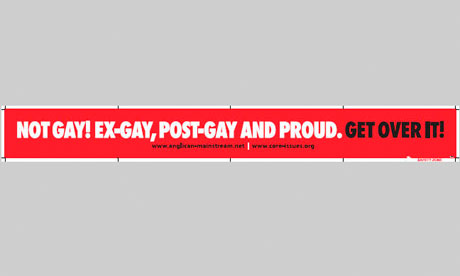
Core Issues Trust's advert states: 'Not gay! Post-gay, ex-gay and proud. Get over it!' mimicking the style of Stonewall's: 'Some people are gay. Get over it' advertising campaign which has run recently.
The full length advert, which will appear on five different routes in the capital, is backed by the Core Issues Trust whose leader, Mike Davies, believes "homoerotic behaviour is sinful". His charity funds "reparative therapy" for gay Christians who believe that they have homosexual feelings but want to become straight. The campaign is also backed by Anglican Mainstream, an worldwide orthodox Anglican group whose supporters have equated homosexuality with alcoholism.
The advert will say: "Not gay! Post-gay, ex-gay and proud. Get over it!" Post-gay and ex-gay are terms used by Christians and some psychotherapists and psychiatrists to refer to homosexual people who have undergone spiritual or pastoral therapy and, according to an Anglican Mainstream definition, have "now left a homosexual lifestyle [and experienced] an increased emotional and sexual attraction to the opposite biological gender and possibly a reduction in or loss of same-sex attraction."
The buses are due to roll out on Monday morning on some of the most popular routes. They will be seen for two weeks travelling past St Paul's Cathedral, down Oxford Street, round Trafalgar Square and through Piccadilly Circus as well as across other parts of the capital.
The campaign is an explicit attempt to hit back at gay rights group Stonewall, which ran its own bus advert saying: "Some people are gay. Get over it." The Christian groups have used the same black, red and white colour scheme as Stonewall and accuses it of promoting the "false idea that there is indisputable scientific evidence that people are born gay".
The Rev Lynda Rose, a spokesperson for the UK branch of Anglican Mainstream said because her group adheres to scripture that all fornication outside marriage is prohibited, it believes that homosexuals are "not being fully the people God intended us to be".
It has sparked an angry response from gay rights campaigners.
The former Europe minister and gay ex-vicar, Chris Bryant MP, said the advert was cruel, particularly to teenagers struggling to come to terms with their sexuality, for promoting the idea that you could become "ex-gay".
"The emotional damage that is done to the individuals who try to suppress their sexuality, the women they marry and the children they might have is immeasurable," he said. "Most sane Christians believe that homosexuality is not a lifestyle or a choice but is a fact to be discovered or not. The pretence that homosexuality is something you can be weaned off in some way is a fundamental misunderstanding of the nature of creation."
Ben Summerskill, the chief executive of Stonewall, said the adverts were clearly homophobic and added: "The only reason some gay people might want to stop being gay is because of the prejudice of the people who are publishing the ad.
"The promotion of this voodoo therapy is hugely irresponsible given the damage that it appears to do to some people."
Attempts to "treat" or alter sexual orientation have been strongly condemned by leading medical organisations. The Royal College of Psychiatrists has warned that "so-called treatments of homosexuality create a setting in which prejudice and discrimination flourish" and concluded in 2010 that "there is no sound evidence that sexual orientation can be changed". The British Medical Association has also attacked "conversion therapy", a related field to reparation therapy, passing a motion asserting that it is "discredited and harmful to those 'treated' ".
Rose said therapies endorsed by Anglican Mainstream and Core Issues were not coercive and stressed that they are appropriate for people who want to change their sexual attractions, for example if they are married and are worried about the impact of a gay lifestyle on their children.
"Reparative therapy works to help men, who want to change their sexual orientation, naturally dissipate their homoerotic feelings and maximise their heterosexual potential," she said.
In a statement, Anglican Mainstream and Core Issues said Stonewall's slogan is "merely another attempt to close down the critical debate about being gay, and marriage 'equality' ". They accused Stonewall of riding roughshod over individuals who chose to "move out of homosexuality".
The statement continued: "Both organisations recognise the rights of individuals to identify as gay, and to live according to their own values. But by the same token, they believe individuals – such as married men and women unhappy with their homosexuality – should be supported in developing their heterosexual potential where this is the appropriate life choice for them … Current scientific research says there is no gay gene and that sexuality is far more fluid than has hitherto been thought."
Wednesday, 11 April 2012
Thomas Cook shares drop amid credit insurance fears
The 170-year-old holiday company, which is trying to secure a fresh financing deal from its lenders, was this morning forced to reassure customers over the security of their bookings following a report that insurance heavyweight Euler Hermes had stopped cover to some Thomas Cook suppliers. Credit insurance protects suppliers, such as independent travel agencies or websites that sell Thomas Cook holidays, in the event that the operator goes bust. Euler Hermes declined to comment on the report. A spokeswoman for the insurance company said it was seeking legal advice on the issue. Thomas Cook confirmed it was aware of Euler Hermes ending its cover to some of its third party suppliers in the UK. Thomas Cook Group But the holiday group insisted it affected only a very “limited” number and no supplier had yet withdrawn its services despite suggestions the move had alarmed third party providers and Thomas Cook staff. The tour operator reassured that Euler Hermes’ decision would have no effect on customers. Thomas Cook said in a statement: “This has zero impact on Thomas Cook customers. We confirm that no product has been removed from sale and no supplier has stopped trading with us. “We are a large Group. This would affect only a very limited number of third party travel providers to Thomas Cook in the UK.” The company, which last year went cap in hand to lenders for emergency funding, insisted it was now doing "just fine”. It added that Euler Hermes did not insure Thomas Cook directly, only third party suppliers, and it was not aware of any other credit insurer taking similar action.
Laser attacks on planes are surging, warn aviation officials
The Civil Aviation Authority (CAA) is warning of a global surge in laser attacks on planes after almost 2,000 incidents were reported in the UK last year. There were 153 incidents at Heathrow in 2011 involving lasers being shone towards aircraft. The second most affected airport was Manchester with 148 incidents, while Birmingham had 143 and Glasgow 107. Liverpool's John Lennon airport had 90 incidents. Throughout the UK last year, the CAA said there were a total of 1,909 incidents, whereas in 2005 there were just 20. At John Lennon airport, a crew member was temporarily blinded as the plane landed following a laser being shone into the aircraft. In October last year, a jumbo jet whose pilot was trying to correct an error after dropping to 300 metres (1,000ft) had a laser shone at it. Incidents in Liverpool peaked during a five-week period last summer, when there were 30 separate laser reports made by pilots who were passing over residential areas as they prepared to land. A CAA spokesman said: "We are currently seeing a global surge in incidents of lasers being deliberately shone at aircraft on final approach to airports. "The aviation industry and the police are doing everything possible to combat the problem and we strongly urge anyone who sees a laser being shone in the night sky near an airport to contact the police immediately." He added: "It's a serious problem and has been getting worse over the last three years. Largely due to the availability of lasers on the internet and the relatively cheap price." Since 2010, shining a laser or light at an aircraft in flight has been a specific criminal offence. The CAA said it needed the public's help to stop the potentially dangerous attacks and urged anyone to contact the police if they witnessed lasers being pointed at planes. The CAA said UK aviation enjoyed an "excellent" safety record because of an open culture of reporting incidents. A spokesman for John Lennon airport said incidents involving flights were few and far between. He said: "JLA is extremely proud of its safety record, which for the period 2007-2011 includes almost 400,000 aircraft movements, accommodating in excess of 25 million fare-paying passengers. "The report from the CAA relating to Liverpool John Lennon airport needs to be put into context as it will include all manner of incidents, many far less serious than others, as well as including incidents occurring away from the airport, but relating to aircraft that originated from here or heading to Liverpool." Ryanair and easyJet flights were targeted as they came in to land at Liverpool at altitudes as low as 150 metres (500ft). One pilot described how the laser "lit up the cockpit" and had a "significant impact" on the flight crew's night vision. An Airbus jet was targeted twice with the first officer's vision "impaired" by the strength of the beam. The captain of another flight needed a medical checkup after "a direct strike to the right eye". In February 2010, a 16-year-old was fined £250 after admitting to shining a laser pen, purchased on eBay for £8, into the cockpit of an easyJet flight from Belfast to Liverpool.
Heathrow airport passes 70m passenger milestone
Heathrow airport saw 70 million passengers pass through its terminals in a 12-month period for the first time in March. BAA – which also owns Stansted, Edinburgh, Glasgow, Aberdeen and Southampton airports – said the figures showed the airport's "resilience" amid challenging economic conditions. Heathrow's five terminals dealt with 5.7 million passengers in March, a 6.9% rise on the previous year as pre-Easter traffic occurred in March, rather than April. BAA airports saw a 4% rise in passengers in the month to 8.6 million as growth at Glasgow and Aberdeen was offset by declines at Stansted, Edinburgh and Southampton. The airline operator, part-owned by Spain's Ferrovial, is working on another legal challenge against a requirement to sell Stansted, after it lost an appeal against the decision earlier this year. Colin Matthews, BAA's chief executive, said: "Reaching 70 million passengers at Heathrow is a major milestone, demonstrating the resilience of the airport in an otherwise challenging economic environment." Heathrow saw an improvement in its load factor, a measure of the use of available capacity on aircraft at the transport hub, which rose by 4.2 percentage points to 73.4% compared with March last year. Elsewhere, Glasgow recorded a 4.6% increase in traffic, while Aberdeen saw a 10.2% rise. Stansted, Edinburgh and Southampton were down 4.7%, 2.8% and 1.7% respectively, with a drop in domestic traffic driving the decline at Edinburgh and Southampton. North Atlantic traffic was up 13.6% across the group, BAA said, while other long-haul traffic increased 5.2%. European scheduled traffic, the group's biggest market, was ahead 3.2%. The strong ski season boosted chartered flights to Europe, BAA added. BAA gave no update on its latest appeal against the Competition Commission's ruling that it must sell Stansted. BAA has mounted a series of legal challenges to the decision, in which time it has also sold Gatwick airport and, faced with having to dispose of either Edinburgh airport or Glasgow airport, opted to sell Edinburgh.
Ocean quake sparks tsunami panic
A massive earthquake off Indonesia triggered tsunami fears across the Indian Ocean sending people in coastal cities fleeing to high ground. A strong aftershock nearly three hours later sparked a new wave of panic. Indonesia's government responded by issuing a fresh tsunami warning which was also later lifted. Some residents were crying in Aceh, where memories of the 2004 tsunami that killed 170,000 people in the province alone, are still vivid. Others screamed "God is great" as they poured from their homes or searched frantically for separated family members. The US Geological Survey said the first 8.6-magnitude quake was centred 20 miles beneath the ocean floor around 270 miles from Aceh province. The Pacific Tsunami Warning Centre in Hawaii lifted a tsunami watch for most areas of the Indian Ocean about four hours after the first quake. It was still in effect for Indonesia, India, the Maldives, Sri Lanka and the island territory of Diego Garcia. A wave measuring less than 30 inches high, rolled to Indonesia's coast. There were no other signs of serious damage. But just as the region was sighing relief, the 8.2-magnitude aftershock hit. Both quakes were strike-slip, not a thrust quakes, according to experts. In a strike slip quake, the earth moves horizontally rather than vertically and doesn't displace large volumes of water. The first tremor was felt in Malaysia, where it caused high-rise buildings to shake for about a minute, and in Singapore, Thailand, Bangladesh and India. It caused chaos in the streets of Aceh. Patients poured out of hospitals, some with drips still attached to their arms. In some places, electricity was briefly cut. Hours afterwards, people were still standing outside their homes and offices, afraid to go back inside. Thailand's National Disaster Warning Centre issued an evacuation order to residents in six provinces along the country's west coast, including the popular tourist destinations of Phuket, Krabi and Phang-Nga. India's Tsunami Warning Centre issued a warning for parts of the eastern Andaman and Nicobar islands. The quake was felt in Dhaka, Bangladesh, where many people in the city's commercial Motijheel district left their offices and homes in panic and ran into the streets. No damage or causalities were reported. In Male, the capital of the Maldives, buildings were evacuated. Indonesia straddles a series of fault lines that makes the vast island nation prone to volcanic and seismic activity. A giant 9.1-magnitude quake off the country on Boxing Day 2004 triggered a tsunami in the Indian Ocean that killed 230,000 people, most of them in Aceh.


